Art and Loneliness After Retirement: How Creative Workshops Build Real Connection
When the Calendar Goes Quiet
For thirty-one years, Meera Kapoor's mornings had the same shape. She would leave home before eight, join the rhythm of colleagues and conversations, and return in the evening with the day's work to talk about. When she retired at 63, she thought she would feel relief.
What she felt instead was the silence.
Her children had moved to different cities. Her husband still worked. The friends she had made through her career were scattered and busy. The phone calls she expected did not quite come, or they came too briefly. Weeks passed in a way she had not anticipated: full of good things, reading, gardening, afternoon walks, but emptier than she had expected of the particular warmth of human contact.
Meera's experience is not unusual. In fact, it has a name, and it has numbers attached to it.
The Loneliness Most People Don't Talk About
Retirement is sold as a destination: the reward at the end of a working life. But for many adults, it arrives alongside a loss that nobody mentions during the planning conversations: the quiet erosion of the social infrastructure that work provided.
Colleagues, routines, professional identity, the ordinary texture of being known and needed. All of it changes at once. And in India, the picture has its own particular complexity. Urban migration has reduced the traditional joint family structure in many households. Adult children move away for work. Neighbours live at a remove. The dense social web that once characterised Indian family life is, for many urban retirees, thinner than it used to be.
The numbers tell a clear story. Research across gerontology and arts participation studies consistently shows that 39% of older adults say that not having someone to do activities with is one of the main barriers to engaging in cultural and leisure life. Among those who live alone, that figure rises to 46%.
These are not just statistics. They represent real people: people managing the quietness of days that feel longer than they should.
Why Art, Specifically
There are many activities that offer structure and stimulus in retirement: book clubs, fitness classes, language courses. But art workshops for over 50s have something different to offer, and it is worth understanding exactly why.
Shared Focus Creates Natural Connection
One of the most socially comfortable things about an art workshop is that nobody has to perform conversation. When you are seated beside someone, both of you concentrating on a watercolour wash or a piece of collage, the conversation that arises is entirely natural. It emerges from the work in front of you. The shared object of attention removes the awkwardness that purely social settings can carry, particularly for people who are meeting strangers for the first time.
This is not a small thing. Many of the barriers that keep older adults from joining social groups (the pressure to be entertaining, the fear of awkward silences, the anxiety of being new) dissolve when there is something in front of you to look at and talk about.
Non-Competition Makes Everyone Welcome
Most social environments, even pleasant ones, carry some element of performance. Art workshops for over 50s, when facilitated well, are among the few spaces where none of this applies. The only thing that matters is the experience of making something. There is no ranking, no comparison, no winner.
This creates an unusually level social environment, one where a retired professor and a former shopkeeper sit beside each other as equals, both discovering watercolour for the first time, both laughing at the same unexpected results. That kind of shared ground is rare, and it is genuinely connecting.
Creative Output Becomes a Shared Language
Something remarkable happens when people make things together: the things they make become a conversation. A finished piece of collage, a small watercolour, a printed block, each becomes a story. "I wanted to capture the hills near my hometown." "These are my mother's favourite flowers." "I have no idea what I was doing, but I love how it turned out."
Art gives people something to talk about that is not age, not health, and not family drama. It opens a window into who someone is without requiring them to explain themselves directly. In a workshop setting, those conversations accumulate into something real.
What the Research Shows
The evidence behind art and social connection in older adults is now substantial enough to be taken seriously as a public health matter.
A major meta-analysis published in Nature Mental Health (2025) examined data from multiple group arts intervention studies and found that participating in group arts programmes was associated with a moderate reduction in both depression and anxiety among older adults. In clinical terms, a moderate effect size is significant: it places creative group activity alongside many recommended mental health and wellbeing interventions.
A scoping review published on PubMed Central found consistent evidence across studies that artistic group activities "stimulate socialisation, which mitigates the perception of loneliness." That phrase, mitigates the perception of loneliness, matters. Loneliness is not simply about being alone. It is about feeling disconnected. Art workshops address the feeling, not just the circumstance.
Luminate Scotland, one of the UK's leading organisations working at the intersection of arts and aging, has documented the role of creative participation as a social intervention tool, a phrase that reflects how seriously practitioners now regard the social function of arts programmes. Their research shows that sustained arts participation creates ongoing community relationships, not just one-off social experiences.
Research from ASA Generations similarly found that creative expression is among the most effective interventions for alleviating elder loneliness, particularly when it is structured, regular, and facilitated by someone trained to hold the group safely.
This is not therapy. It is not a support group. It is something people choose because it is enjoyable, and the social benefits arrive as a natural consequence.
What a Session at Art Beyond Age Actually Looks Like
If you have never been to a creative aging workshop, it can be difficult to picture what one actually feels like. Here is what a typical session at Art Beyond Age looks like in practice.
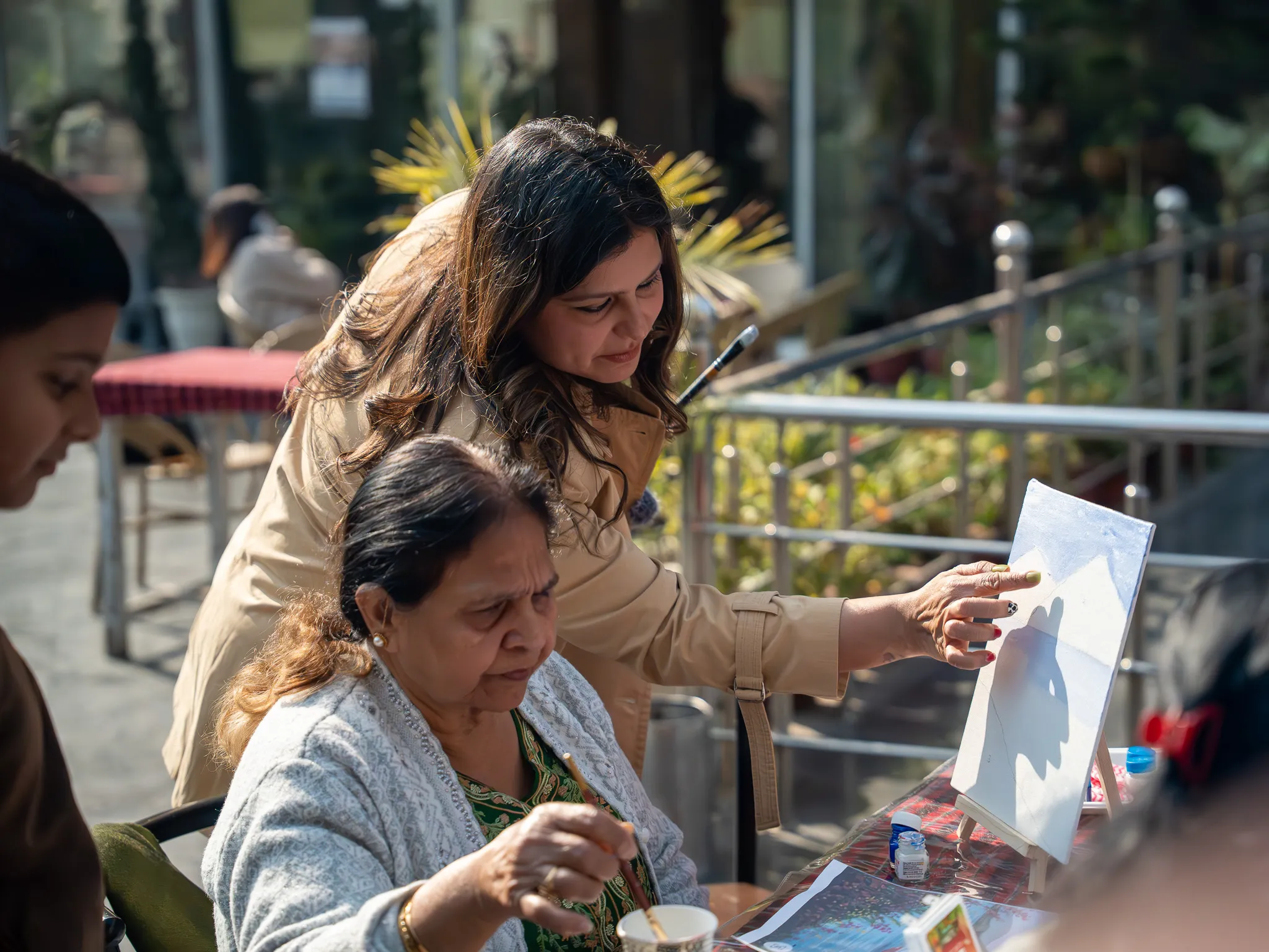
You arrive and are greeted by name. The studio space is set up: materials laid out, tea available, the facilitator moving between tables as participants settle in. People know each other's names, or are learning them. The conversation is easy.
The session begins with a short introduction to the day's medium or theme. Nothing is assumed about prior experience. The facilitator meets everyone where they are, and the focus shifts to the making. For the next hour or so, the room has that particular quality that artists describe as flow: a gentle absorption in what is in front of you, punctuated by the kind of conversation that only happens between people who are not trying too hard.
At the end of the session, work is shared, not for critique, but because sharing is joyful, and because what people have made is worth seeing. The conversation afterwards is warm, unhurried, and often continues over a cup of tea long after the session ends.
People come back, session after session, not just because the art is meaningful, but because the people are.
This is what creative aging looks like in practice: not a programme, but a community, built around the act of making things together.
The Connection You Did Not Know You Were Looking For
Meera did not join an art workshop because she was lonely. She joined because she had always wanted to try watercolour and kept putting it off. What she found, after a few sessions, was something she had not thought to look for: a group of people she genuinely liked, a regular commitment in her diary she found herself anticipating, and for the first time since retirement, the feeling of being part of something.
That is what art workshops for older adults, done well, can offer. Not just a pleasant way to spend an afternoon, but a genuine social infrastructure, one built around creativity, warmth, and the very human pleasure of making something alongside people who understand exactly where you are in life.
Join a Workshop: Meet People, Make Art
If any of this resonates with what you have been looking for, the most useful thing you can do is simply show up.
Browse our upcoming workshops and find a session that works for you. No experience is needed. No particular social ease is required. Just bring your curiosity, and let the rest follow.
If you would like to explore further, you might enjoy our guide to what creative aging really means, or coming soon, our piece on why "I'm not artistic" is exactly the reason you should try an art workshop after 50 (coming soon).
We would love to see you there.